
Introduction:
Homeopathy stands out as a controversial and unique part of alternative medicine because of its long history and popularity. This blog will shed light on the history behind homeopathy and how it became what it is today.
Origins:
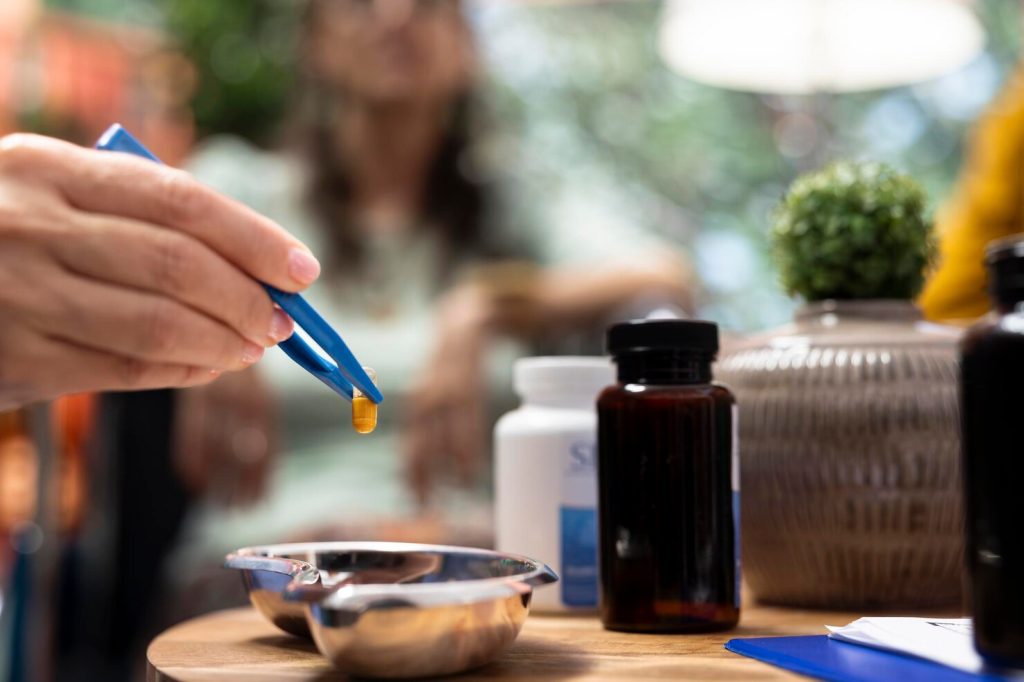
Homeopathy dates back to the late 18th century in Germany. It was created by Samuel Hahnemann, a German physician, who wanted to find a medical treatment with fewer side effects than the ones popular at the time. He developed the principle that “like cures like”: a substance that causes symptoms in a healthy individual can cure the same symptoms in a sick person. To make a Homeopathic treatment, a drop of a substance is diluted in water at least 6 times: a drop is diluted in water, and a drop of that solution is then diluted again for 6 rounds.
Rise to popularity:
Homeopathy was introduced into the world by Hahnemann’s book “Organon of the Medical Art” and then became popular because of its gentle ideals and methods. First, most other treatments were very harsh and could even be counterproductive and worsen the patient’s condition. For example, bloodletting was a common practice, and it (for the most part) did not cure any peoples’ illnesses; in fact it led to infections and even death. Homeopathy has no negative effects when used correctly, so compared to treatments like bloodletting, it had a much higher success rate. In addition, homeopathy practitioners often focused on treating an individual as a whole and seemed to be more personal than mainstream medicine, so patients gravitated toward it more.
Controversies in Homeopathy:
According to chemistry and science, once a drop of a substance is diluted to 6x, there is no molecule of the original substance in the solution anymore. This creates a connectivity issue because Homeopathy claims that the substance is still actively curing the patient’s symptoms but there is no active ingredient in the treatment. Homeopathy’s explanation for this is that the water used for dilution retains a memory of the substance at the molecular or atomic level, but there is no evidence that this is true, and the current scientific understanding of chemistry points against it. Even so, homeopathy has definitely had many successes throughout history. The main question is how it actually helps the patients: does the water actually have a memory of the substance or does it just operate on placebo effect? Or does it actually have no effects at all and just allow the symptom to run its course and naturally stop? The next blog will explore the arguments for each of these cases.
Conclusion:
Without question, homeopathy is one of the most popular alternative medicines in the world because of its appeal as a non-invasive, easy, and side-effectless treatment, and there have been many cases of its success. In addition to hospitals and private practitioners, homeopathic treatments are also sold in large pharmacies such as CVS. Even so, arguments against it are at least as strong as arguments for it, leading to controversies and doubts.